UCP Bearing Complete Guide: Types, Dimensions, Load Ratings & Selection Tips
A UCP bearing unit combines an insert ball bearing with a P-type pillow-block housing. In practical machine design, that means the bearing, sealing, lubrication access and mounting base arrive as one serviceable support rather than as a loose bearing that still needs a separately machined housing.
The model code is only the starting point. Shaft diameter, centre height, bolt spacing, load direction, contamination and the shaft-locking method all have to agree with the machine. This guide follows those decisions in the same order a buyer or maintenance engineer normally faces them.
What a UCP bearing is
The insert has a spherical outside surface that mates with the spherical seat in the housing, giving the assembly a self-aligning function for modest mounting errors. The standard set-screw style uses an extended inner ring with two screws positioned around the shaft. The housing provides the base, grease access and the mounting geometry that fixes shaft centre height.
For replacement work, treat the complete unit as two interfaces at once: the insert must fit the shaft, while the housing must fit the machine base. A correct bore with the wrong centre height or bolt spacing is not a usable replacement.
UCP families and related pillow-block types
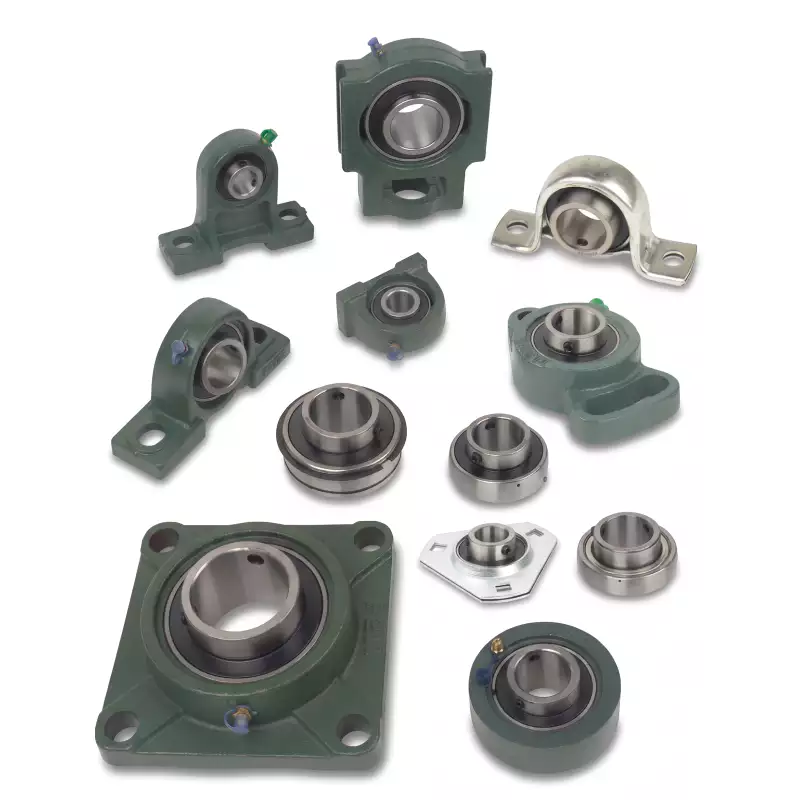
The planning range covers standard EP-UCP units, eccentric-collar families such as EP-NAP, higher-centre-height EP-UCPH types, tapped-base formats such as EP-UCPA, pressed-steel light-duty housings and tapered-bore EP-UKP units used with H-series adapters. These are not interchangeable labels; each changes the shaft connection, housing or duty envelope.
- EP-UCP: set-screw locking on a straight shaft; the general-purpose starting point.
- EP-NAP / SA-related families: eccentric-collar locking where the locking method is part of the application decision.
- EP-UKP + H adapter: tapered-bore insert combined with an adapter sleeve for a straight shaft.
- Pressed-steel pillow blocks: lighter housings for lower-duty machinery where a cast housing is unnecessary.
- Engineering-plastic housings: considered when corrosion, washdown or chemical exposure drives the housing decision.
How to read UCP dimensions
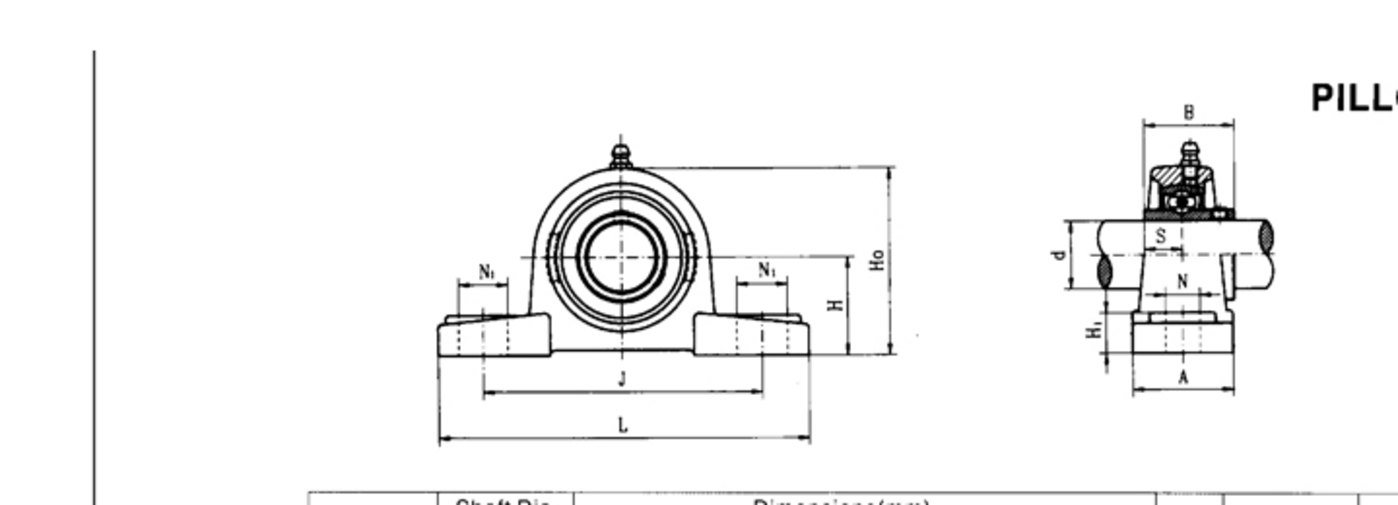
On the dimensional drawing, d is the shaft bore, H is shaft-centre height, J is the distance between mounting holes and L is the overall base length. Dimensions such as A, N, H1, H0, S and B complete the housing envelope and bearing projection.
| Model | Shaft d | H | L | J | Bolt |
|---|---|---|---|---|---|
| EP-UCP204 | 20 mm | 33.3 | 127 | 96 | M10 |
| EP-UCP205 | 25 mm | 36.5 | 140 | 105 | M10 |
| EP-UCP206 | 30 mm | 42.9 | 160 | 121 | M12 |
| EP-UCP207 | 35 mm | 47.6 | 167 | 127 | M12 |
| EP-UCP208 | 40 mm | 49.2 | 180 | 137 | M12 |
| EP-UCP209 | 45 mm | 54.0 | 189 | 146 | M12 |
| EP-UCP210 | 50 mm | 57.2 | 204 | 159 | M16 |
Load ratings and service-life meaning
Dynamic load rating C is used in rolling-bearing life calculations; static rating C0 is used when permanent deformation under high stationary or shock loading is the concern. The rating belongs to the insert-bearing configuration, not to the housing shape alone. For example, the supplied EP-UC205 data lists a dynamic rating of 10.8 kN and a static rating of 7.88 kN, while larger inserts carry different values.
Do not select a UCP unit by rating alone. Equivalent load, speed, lubrication, contamination, mounting quality and the desired service interval all affect life. If the duty contains a meaningful axial component, confirm the bearing calculation rather than treating a radial rating as a complete machine rating.
A practical five-step selection method
- Fix the shaft size. Measure the shaft; do not round a metric shaft to the nearest inch size or vice versa.
- Define the load and speed. Record radial load, any axial component, shock, starts and stops, and running speed.
- Describe the environment. Dust, mud, moisture, washdown chemistry and temperature can change housing, seal and lubrication choices.
- Choose the locking method. Keep set-screw, eccentric-collar and adapter-sleeve systems distinct.
- Verify the housing interface. Compare centre height, bolt pattern, overall envelope and service access against the actual machine.
UCP vs UCF vs UCFL vs UCFC
Use EP-UCP when the support sits on a base under a shaft. Use EP-UCF when a four-bolt flange mounts to a machine face, EP-UCFL when a compact two-bolt flange is preferred, and EP-UCFC when a round cartridge-style flange better suits the mounting geometry. Housing choice is therefore an interface decision before it is a marketing category.
| Housing family | Mounting form | First dimensions to check |
|---|---|---|
| EP-UCP | Two-bolt base | d, H, J, L |
| EP-UCF | Four-bolt square flange | d, flange size, bolt pitch, projection |
| EP-UCFL | Two-bolt oval flange | d, two-hole spacing, flange envelope |
| EP-UCFC | Round flange cartridge | d, circular flange dimensions, bolt pattern |
Frequently asked questions
Are UCP bearings self-aligning?
The spherical outside surface of the insert and the matching housing seat allow the unit to accommodate modest mounting error. This construction provides a self-aligning function, but no single angular limit should be applied to every configuration without model-specific data.
Can a UCP unit carry thrust load?
Insert ball bearings can carry a limited axial component in addition to radial load, but the acceptable amount depends on size, speed, fit and duty. Use a bearing calculation for a design with significant thrust.
What is the speed limit?
There is no single UCP speed limit across all sizes and seal arrangements. Confirm the limit for the ordered insert, lubrication and operating temperature.
How long will a UCP bearing last?
Service life depends on dynamic load, speed, lubrication, contamination and mounting quality. Use rating-life calculations as a starting point and adjust maintenance plans for the real environment.
A practical UCP selection workflow
Start with the shaft and the machine frame, not with a preferred model number. Record the actual shaft diameter, whether it is metric or inch, the available base length, centre height and bolt spacing. Then identify whether the current support is fixed or adjustable, and whether the insert locks with set screws, an eccentric collar or an adapter sleeve. Only after those interface questions are settled should load, speed, contamination and lubrication be used to screen the available series.
| Selection question | Why it matters | Typical result |
|---|---|---|
| How is the unit mounted? | Determines housing family and bolt pattern | EP-UCP base mount, EP-UCF / EP-UCFL face mount, EP-UCT take-up |
| How is the shaft locked? | Changes insert and installation procedure | Set screw, eccentric collar or adapter sleeve |
| What contaminates the bearing? | Influences seal, housing and maintenance approach | Dry dust, crop debris, water, washdown or abrasive material |
| Is the shaft metric or inch? | A close nominal size is not a fit | Measure and use the complete part number / suffix |
How load ratings should be used
Dynamic and static ratings are bearing-selection inputs, not a guarantee of service life. The dynamic value is used in rating-life calculations with the equivalent applied load; the static value becomes important when heavy shock or very low-speed loading can create permanent contact deformation. Housing strength, shaft fit, lubrication and contamination can become the real limit before the theoretical bearing rating is reached. For a new design, calculate from the actual radial and axial loads rather than copying a model used on a visually similar machine.
What to record for future replacement
Once a model is approved, save the EP part number together with the shaft diameter, mounting dimensions, locking method and machine position. That neutral interface record is more useful than a brand-only cross-reference when equipment has been modified over time. A photo of the installed unit and a marked-up dimensional drawing can prevent future maintenance teams from selecting the correct bore in the wrong housing.
Need a model checked against your machine? Send the dimensions with your RFQ.