UCP Bearing Supplier for the United States | EVER POWER
English-language product selection and RFQ guidance for local machinery buyers.
US buyers often approach housed bearing replacement from the shaft first: many legacy conveyors, farm machines, grain-handling systems and fan assemblies use inch shafts, while newer equipment may use metric dimensions. The safest buying path is to confirm the actual shaft diameter, housing footprint and locking method before treating a familiar series code as a drop-in replacement.
Terminology and product identification
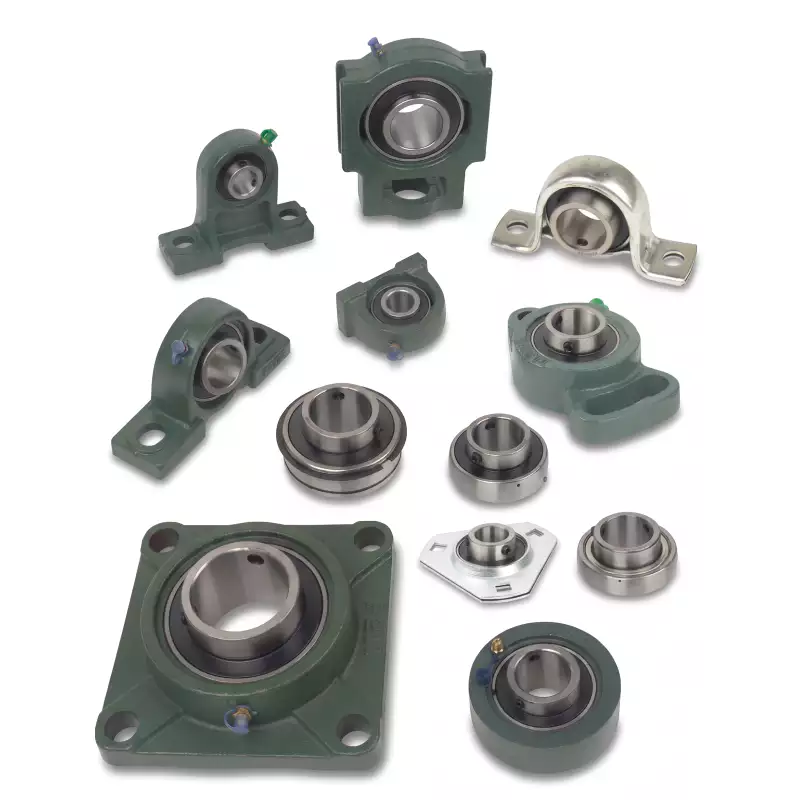
US terminology commonly uses “pillow block bearing,” “mounted bearing” and “housed bearing unit.” Inch-bore suffixes may appear on UCP-style references, so include the complete code rather than only the base model.
Industries and bearing-unit decisions
| Industry | Typical equipment | Series to review | What to confirm |
|---|---|---|---|
| Grain handling | Elevators, augers, belt and chain conveyors | EP-UCP, EP-UCT and flange families | Shaft size, take-up travel, contamination and maintenance access |
| Agricultural machinery | Combines, balers, planters and tillage equipment | EP-UCP, EP-SA / EP-NAP families and disk-harrow units | Shock, mud, seasonal storage and exposed seals |
| Mining and aggregates | Conveyors, screens and auxiliary rotating shafts | Larger EP-UCP, eccentric-lock or adapter-sleeve families | Vibration, abrasive dust and mounting rigidity |
| Food and packaging | Packaging lines and washdown-adjacent conveyors | Plastic-housing or corrosion-sensitive configurations | Cleaning chemistry, lubricant requirements and hygiene zone |
| HVAC and air handling | Fan, blower and air-handler shaft supports | EP-UCP, EP-UCF, EP-UCFL and EP-UCFB-style mounting | Speed, alignment, flange pattern and guard clearance |
Metric and inch bore checks for US equipment
Do not round a metric shaft to the nearest inch. For example, a 25 mm shaft is not the same interface as a 1 inch shaft. When the existing reference uses an inch suffix, send the full part number and a measured shaft diameter. Also record centre height for pillow blocks or the bolt circle / flange pitch for face-mounted units. This prevents a correct bearing bore from being paired with the wrong housing footprint.
What to send with a US replacement RFQ
A useful RFQ includes the existing model, actual shaft diameter, two or three housing measurements, quantity, machine type and an installation photo. If the unit is in a dusty grain elevator, wet agricultural location or high-cycle conveyor, say so. When a buyer needs material, inspection or packaging documents, list those requirements in the enquiry rather than assuming a generic certificate applies to every configuration.
Where to start in the EVER POWER range
For a dimensional starting point, compare the EP-UCP 200-series tables for base-mounted shafts and EP-UCF or EP-UCFL tables for flange-mounted positions. Take-up frames should be checked against EP-UCT housing geometry and available adjustment travel.
For US projects, use the dimensional tables as a screening tool, then confirm the exact ordered configuration from the machine interface and duty. When a third-party model number is supplied, it is treated as an identification input rather than proof of exact compatibility.
Frequently asked questions
Can I order an inch-bore pillow block for US equipment?
Yes, inch-shaft applications can be reviewed, but the exact shaft diameter and complete existing reference should be supplied so the bore and housing geometry can be confirmed.
Is the US page translated into a different language?
No. The website uses English consistently. Market-specific terminology is explained only where it helps identify a product or prepare an RFQ.
What is most important for a replacement unit?
Confirm shaft diameter, mounting geometry, locking method, operating environment and the existing model. Brand or series names alone are not enough to prove interchangeability.
Request a market-specific bearing quote
Send the model or current reference, shaft diameter, housing dimensions, application, quantity, destination and any drawing or documentation requirements.