Bearing Unit Sealing Types Explained: 2RS, Triple-Lip Seal, Labyrinth — Which Is Best?
Seals decide how easily dirt, water and other contaminants reach the rolling elements and grease. The “best” seal is therefore application-specific: a contact seal that excludes mud may create more friction than a non-contact arrangement chosen for speed, while a washdown environment may require both corrosion-resistant materials and a seal/lubricant system that tolerates water exposure.
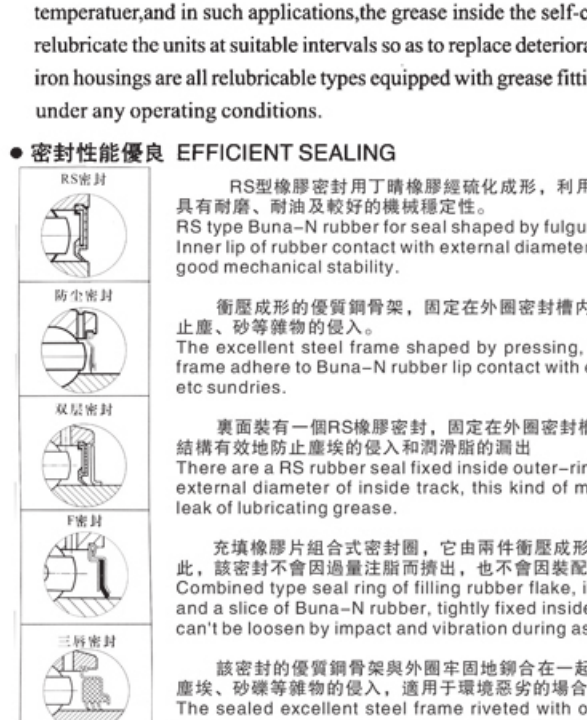
The supplied bearing-unit material shows several sealing constructions, including RS rubber seals, dustproof covers, labyrinth-style arrangements and multi-lip structures.
Standard rubber contact seals
Rubber-lip seals contact the rotating inner-ring region to retain grease and exclude common contamination. These are the general-purpose starting point for many indoor and light outdoor bearing units. Their performance still depends on speed, temperature, shaft condition and chemical compatibility.
Triple-lip / heavy contamination arrangements
Multi-lip constructions increase the number of barriers between the environment and the bearing. They are worth considering in agriculture, mining, fibrous material handling and wet outdoor service where mud or abrasive dust would challenge a standard arrangement. The extra contact and structure should be balanced against speed and heat.
Labyrinth-style sealing
A labyrinth uses a tortuous path rather than relying only on a contacting lip. Because non-contact portions can reduce friction, labyrinth concepts are useful where speed matters, but they are not automatically the best option for immersion or aggressive washdown. Exact construction varies by bearing family.
Felt and specialty seals
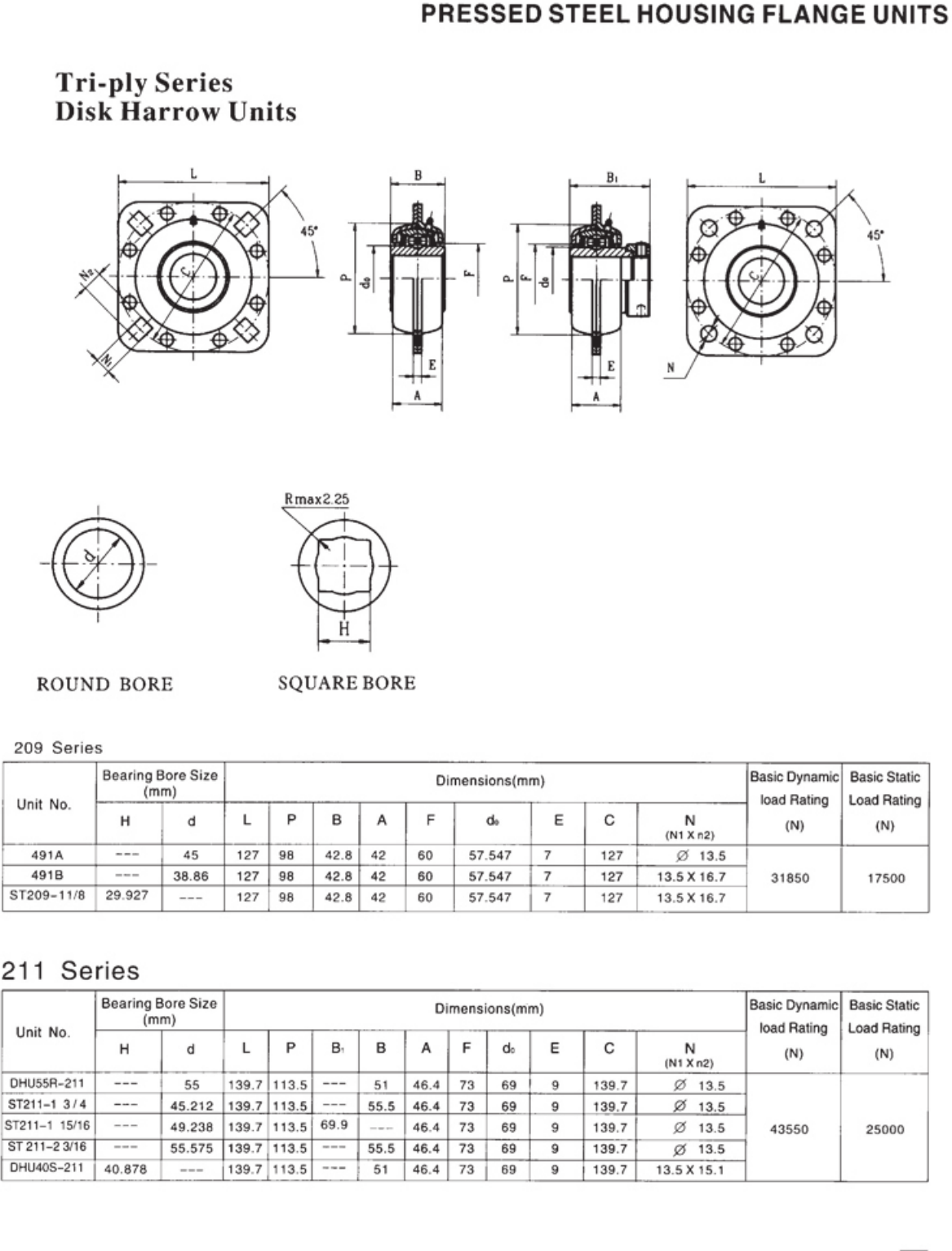
The supplied product material also shows specialty sealing used in applications such as disk harrow units. Felt or scraper elements can help in low-speed muddy service. These arrangements should be ordered as part of the intended unit rather than improvised onto a standard insert after the fact.
Quick selection guide
| Environment | Seal direction to review | Other checks |
|---|---|---|
| Clean indoor machinery | Standard contact-seal arrangement | Speed, grease and temperature |
| Dry dust / agriculture | Multi-lip or additional exclusion features | Relubrication and shaft condition |
| Mud / wet field duty | Heavy contamination / tri-ply style where available | Housing material and grease purge strategy |
| Higher speed | Lower-friction/labyrinth concepts where designed | Temperature and contamination level |
| Washdown / chemical exposure | Contact sealing plus corrosion-resistant assembly | Chemical, temperature, lubricant documentation |
Seal selection is part of the complete unit
Do not select the seal independently of the housing and insert. A corrosion-resistant housing with an unsuitable insert or lubricant can still fail in washdown. A heavy contact seal on a high-speed application can create heat. Put speed, environment, chemical exposure and service access in the RFQ so the complete configuration can be reviewed.
Seal selection starts with the contaminant
| Environment | Seal objective | Selection note |
|---|---|---|
| Clean indoor machinery | Retain grease and exclude light dust | A standard contact-seal arrangement may be sufficient if speed/temperature allow |
| Agriculture / mining | Scrape or exclude mud, fibre and abrasive dust | Review multi-lip / additional protection and relubrication strategy |
| High-speed clean service | Reduce seal drag while retaining protection | Check the exact insert speed and seal options |
| Washdown / food-adjacent | Water/chemical exclusion and material resistance | Seal, housing, insert and lubricant must be specified together |
IP-style shorthand can mislead
A housed bearing seal should not be assigned a generic enclosure IP rating unless the manufacturer has actually tested and declared that exact configuration to the relevant method. Describe the seal construction and the actual contamination / water exposure instead. For immersion, direct high-pressure jets or aggressive chemicals, request a configuration-specific review.
Seal failure can be a system problem
Repeated seal damage can result from excessive speed, shaft roughness, misalignment, chemical attack or guard interference. Replacing the seal style without correcting the cause may only postpone the same failure. Include photos of the damaged seal and shaft in the next RFQ.
Need a model checked against your machine? Send the dimensions with your RFQ.