How to Calculate Bearing Service Life for UCP Pillow Block Bearings
Bearing rating life gives engineers a consistent way to compare a bearing’s dynamic capacity with the load and speed it is expected to see. It is not a warranty of operating hours: contamination, lubrication, mounting, shock and temperature can shorten field life even when the basic calculation looks comfortable.
For a ball-bearing insert, the basic L10 calculation uses the dynamic rating C and the equivalent dynamic load P. Ninety percent of a sufficiently large population of identical bearings operating under the calculation assumptions would be expected to exceed the L10 rating life.
Basic rating-life formula
C is the basic dynamic load rating of the insert and P is the equivalent dynamic bearing load. To convert revolutions to hours at constant speed n:
Choose the correct C value
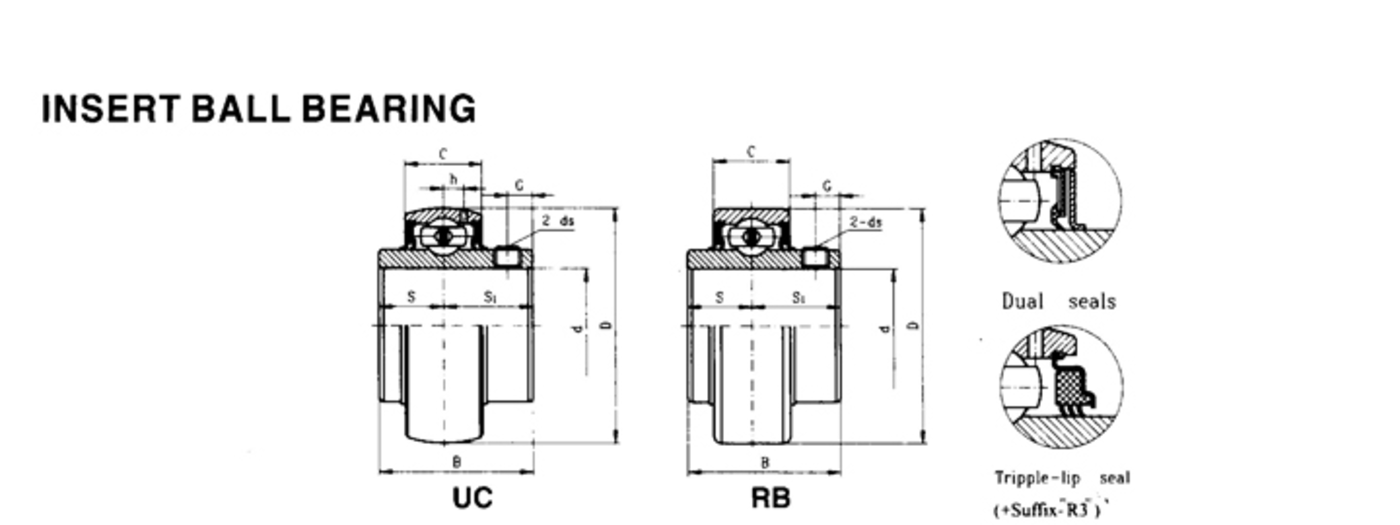
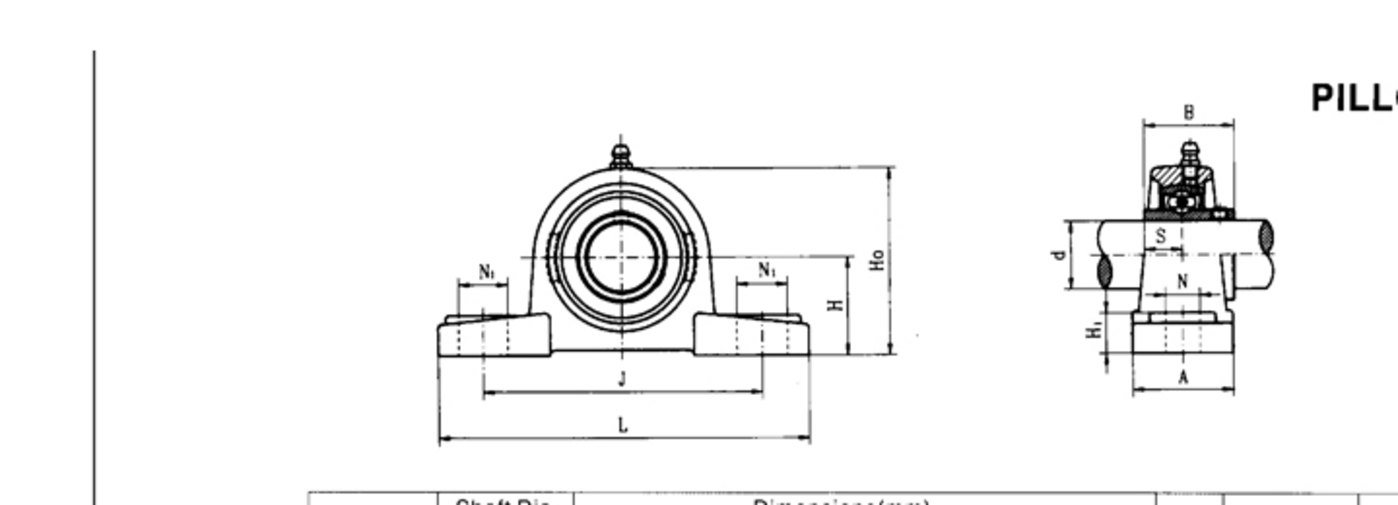
Use the rating for the exact insert bearing, not the housing model name alone. In the supplied table, EP-UC207 has C = 19.8 kN and C0 = 15.2 kN. The UCP housing carries that insert, while the housing dimensions determine how the assembly fits the machine.
Determine equivalent load P
For a predominantly radial application with only a small axial component, P may be close to the radial load. When axial load becomes significant, bearing calculation factors are needed and P should not be guessed. Belt tension, sprocket force, product load and shaft weight may all contribute to the bearing reaction.
Worked example: EP-UCP207 on a conveyor shaft
Assume the EP-UC207 insert carries an equivalent radial load of 2.5 kN at 800 rpm. Using C = 19.8 kN:
L10 = (19.8 / 2.5)3 × 10⁶ ≈ 496.8 million revolutions.
L10h = 496.8 × 10⁶ / (60 × 800) ≈ 10,350 hours.
This is a basic rating-life result under the simplified load assumption. It does not include contamination, lubrication condition, unusual shock or installation error.
Adjusted life and real operating conditions
Engineering standards use modification factors to account for reliability, lubrication and contamination. Even without performing a full adjusted-life calculation, the lesson is practical: a dusty conveyor with poor grease control should not be maintained as though it were a clean laboratory bearing running at the same calculated load.
When to upsize or change the bearing selection
If basic life is well below the machine requirement, options include a larger insert family, a heavier series, lower load at the bearing point or a change in bearing arrangement. If shock or shaft locking is the real problem, changing from a UCP set-screw unit to another locking family may be more relevant than simply increasing bearing size.
Keep calculation data with the RFQ
| Input | Record for selection |
|---|---|
| Bearing insert / candidate model | Exact C and C0 source row |
| Radial reaction | kN at each bearing support |
| Axial reaction | kN and direction |
| Speed | rpm and duty cycle |
| Environment | Dust, water, temperature, washdown |
| Required life | Hours or revolutions plus reliability target |
Rating life is a comparison tool, not a calendar promise
The basic L10 equation estimates fatigue life for a population of bearings under defined load and speed assumptions. It does not include every real-world cause of failure. Contamination, poor lubrication, mounting errors, shaft wear, vibration and housing distortion can reduce actual service life far below a clean laboratory-style calculation.
Check the equivalent load carefully
For a predominantly radial insert-bearing application, radial load may dominate the equivalent dynamic load, but significant axial load requires the applicable X/Y factors and bearing data. Use the manufacturer or design standard for the exact insert. Do not copy a factor from another series just because the bore is the same.
Use the calculation to compare options
Calculate candidate models under the same load and speed assumptions, then check the housing and shaft interface. If a larger bearing improves theoretical life but requires an incompatible centre height or base footprint, the machine may need redesign. Finally, apply a maintenance and contamination review so the calculation reflects the operating environment.
Need a model checked against your machine? Send the dimensions with your RFQ.