UCP vs UCF vs UCFL: Choosing Between Pillow Block and Flange Bearing Units
UCP, UCF and UCFL units may use related insert-bearing technology, but their housings solve different mounting problems. The quickest way to choose among them is to look at the machine surface: does the support sit on a base below the shaft, or does it bolt to a vertical or side face?
That mounting decision determines which dimensions must be controlled in the drawing and which replacement measurements matter most.
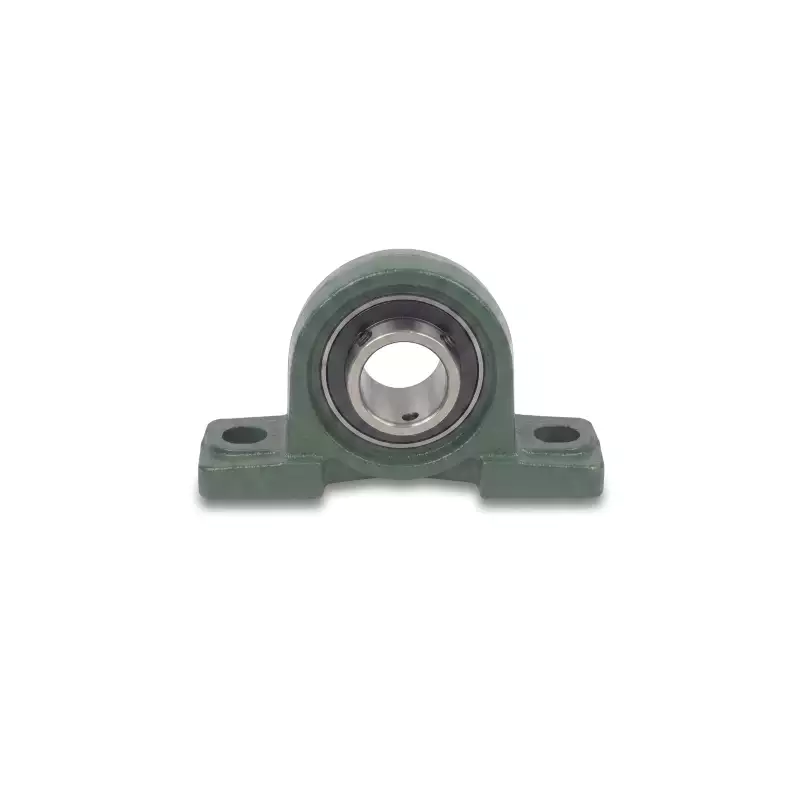
EP-UCP: two-bolt pillow block
EP-UCP is a base-mounted housing. The shaft runs parallel to the support surface, so centre height H, base length L and bolt spacing J are primary interface dimensions. UCP is the natural choice for many horizontal conveyor shafts, agricultural drives, rollers and general machinery frames.
EP-UCF: four-bolt square flange
EP-UCF mounts to a machine face with four bolts around the shaft. A flange unit is useful where a separate base beneath the shaft is inconvenient or where the shaft projects through a side plate. For replacement, measure flange width/height, bolt pitch and projection in addition to bore.
EP-UCFL: two-bolt oval flange
EP-UCFL uses a narrower two-bolt flange, reducing the mounting-face footprint where a four-bolt square casting would occupy too much space. It still requires the shaft bore, two-hole spacing and front-to-back projection to match the machine.
Where EP-UCFC fits
Round flange cartridge units provide another face-mounted option where a circular housing shape and more concentric cartridge-style geometry suit the machine. They are frequently considered for pump, fan or equipment housings where the support is built around the shaft centre rather than a floor base.
Mounting-orientation decision guide
| Machine condition | Typical starting family | Why |
|---|---|---|
| Horizontal shaft supported from a base | EP-UCP | Centre-height and base-bolt geometry define the support |
| Shaft through a flat machine face; four bolts available | EP-UCF | Rigid four-bolt flange around shaft centre |
| Face mount with limited width | EP-UCFL | Two-bolt oval flange saves face area |
| Round cartridge-style machine opening | EP-UCFC | Circular flange format follows shaft-centred geometry |
Do not replace by bore alone
A 25 mm bore can appear in several housing families, but those units do not share the same bolt pattern, centre height or outside envelope. For a retrofit, photograph the complete housing and record the mounting dimensions before choosing the new family.
If the machine designer has freedom to choose a new housing type, compare service access too: grease fitting location, ability to remove the insert, nearby guards and tool access can be as important as nominal housing weight.
Mounting orientation is the fastest first filter
| Machine interface | Housing family to review | Reason |
|---|---|---|
| Horizontal base under shaft | EP-UCP | Two-bolt foot supports a shaft parallel to the base |
| Square side plate / four holes | EP-UCF | Four-bolt face mounting |
| Compact side plate / two holes | EP-UCFL | Oval two-bolt face mounting |
| Round machined face | EP-UCFC | Cartridge-style circular housing |
| Compact bracket on one side | EP-UCFB-style housing | Use only when the bracket geometry matches |
Housing choice does not replace insert selection
After the housing style is chosen, the insert still has to match the shaft and duty. Bore, locking method, insert width, sealing and lubrication remain separate checks. This is why “UCF instead of UCP” is not only a change in bolt pattern: it can also change shaft projection, tool access and how the support reacts to the frame.
Replacement measurements
For a base-mounted UCP, record bore, centre height and base bolt spacing. For UCF or UCFL, record bore plus horizontal/vertical or two-hole pitch, flange envelope and any pilot. For UCFC, include the circular housing diameter and register. Those measurements make the selection independent of a possibly incomplete old part number.
Need a model checked against your machine? Send the dimensions with your RFQ.