How to Read a Bearing Unit Part Number: UCP, UCF, NAP Naming System Decoded
Bearing-unit codes are compact descriptions of the insert family, housing form, series and bore. Once the pattern is familiar, a model such as UCP205 immediately tells you more than “a 25 mm bearing” — but the code still does not replace a drawing when a machine is being repaired or redesigned.
The safest way to decode a part number is to separate the letters that describe construction from the numbers that describe series and bore.
Break down UCP205
UC identifies the set-screw insert-bearing family and P identifies a pillow-block housing. The first digit of the size group places the unit in its series family, while the final two digits are the bore-size code used in the standard numbering system. For common codes 04 and above, the last two digits multiplied by 5 give the nominal metric bore in millimetres: 05 corresponds to 25 mm, 06 to 30 mm and 10 to 50 mm.
Do not extend that shortcut blindly to every special or small-bore code. Use the actual table for the ordered model.
Housing letters at a glance
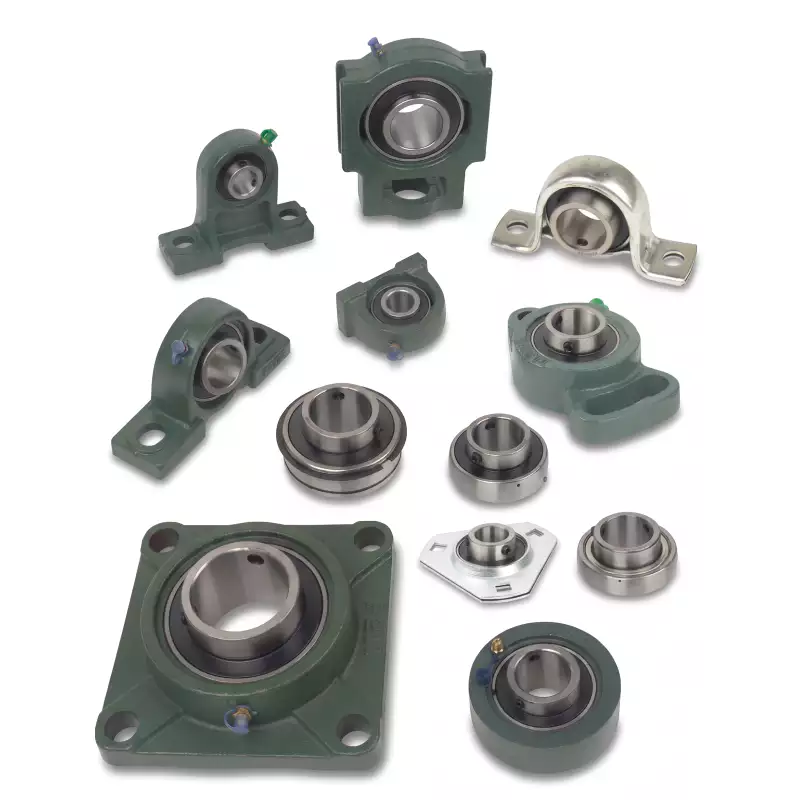
| Housing code | Typical form | Machine interface |
|---|---|---|
| P | Pillow block | Two-bolt base under shaft |
| F | Square flange | Four-bolt machine face |
| FL | Oval flange | Two-bolt machine face |
| FC | Round flange cartridge | Circular face mount |
| T | Take-up | Sliding tension frame |
| FB | Flange bracket | Bracket-style face support |
| HA | Hanger | Suspended/hanger mounting |
Locking-family prefixes
A UC-based unit uses set screws on the extended inner ring. NA/NAP and SA-related codes identify eccentric-collar arrangements. UK identifies a tapered-bore insert that uses an H-series adapter sleeve. These prefixes change the installation method and should not be dropped when a purchasing system shortens the model description.
Inch-bore suffixes
Inch-oriented UCP models add a dash suffix based on sixteenths of an inch. For example, UCP205-16 is a 1-inch bore and UCP206-19 is a 1-3/16-inch bore. Multiple inch-bore suffixes can exist within one housing size, which is why “UCP205” without the suffix can be ambiguous on North American equipment.
| Example | Meaning |
|---|---|
| UCP205 | Metric 25 mm bore in the listed standard row |
| UCP205-16 | 1-inch bore variant |
| UCP206-18 | 1-1/8-inch bore variant |
| UCP206-19 | 1-3/16-inch bore variant |
| UCP206-20 | 1-1/4-inch bore variant |
Practical decoding examples
- UCFL208: UC set-screw insert in a two-bolt oval flange housing, size code 08.
- NAP207: eccentric-locking pillow-block family, size code 07.
- UKP + H adapter: tapered-bore insert in a pillow-block housing with the matching adapter sleeve.
- S.UCP-style family: engineering-plastic housing configuration around a UCP-style mounting format.
- UCPH210: high-centre-height pillow-block variation in the 210 size family.
Use the code with the drawing
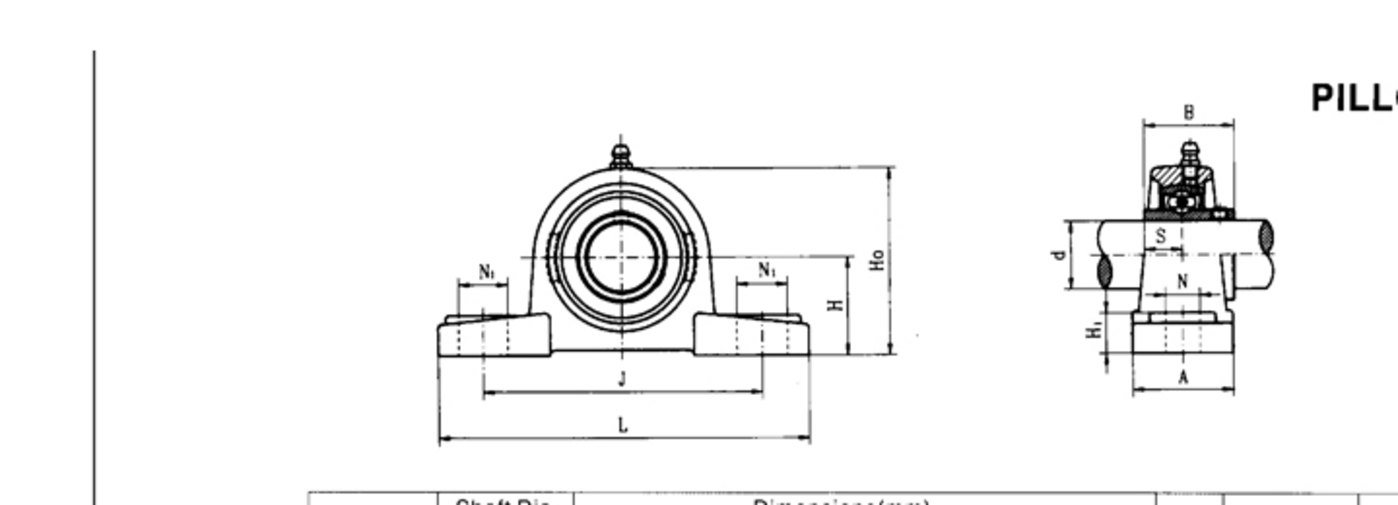
A part number is an efficient filter, not a substitute for the machine interface. If a model is being cross-referenced, confirm bore, centre height or flange pattern, bolt spacing, insert width and locking method. Keep suffixes and special letters in the RFQ because they often carry the information most likely to be lost in an informal description.
Why codes must be read as a system
A part number can communicate housing family, insert family, bore and locking approach, but the exact convention varies across series. Treat the code as a structured hint, then confirm the dimensional table. This is especially important with alternative prefixes such as NA or UK and with inch-bore suffixes that change the shaft interface.
The EP- prefix is a display identity, not a technical change
On this website, EVER POWER model names are displayed with an EP- prefix. EP-UCP205 therefore identifies the EVER POWER UCP205 model; the prefix does not change the technical dimensions stored for the model. The same rule applies to EP-UCF, EP-UCFL and EP-UC references.
Three examples of a complete identification record
For a pillow block, keep the full model, bore, centre height and bolt spacing. For a flange unit, keep the full model, bore and flange hole pitch. For an insert-only purchase, keep the insert model, housing model and locking method. These records remain useful even if a label is damaged later.
Need a model checked against your machine? Send the dimensions with your RFQ.